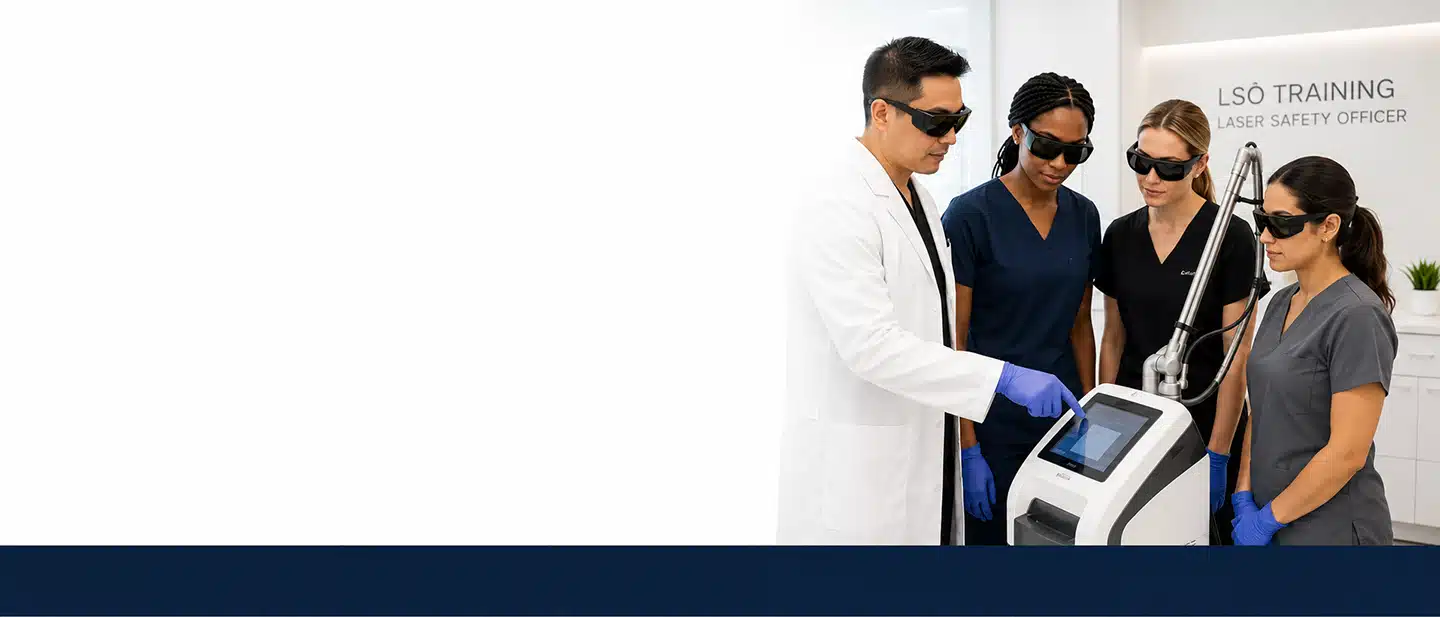
Build the knowledge needed to recognize laser hazards, support a structured safety program, protect staff and patients, and prepare for Laser Safety Officer responsibilities in medical, aesthetic, research, educational, and industrial settings.
100% OnlineStudy from anywhere
Self-Paced AccessComplete training on your schedule
Printable CertificateIssued after successful completion
Verification IDProfessional completion record
Build foundational knowledge in laser hazard recognition, control measures, documentation, and workplace safety through a professional online laser safety course. Designed for medical professionals, estheticians, clinic teams, and other personnel who work around laser systems, this training connects recognized laser safety principles with practical program responsibilities.
This 15-hour online laser safety training course provides structured education for personnel preparing to support or assume Laser Safety Officer (LSO) responsibilities in medical, research, aesthetic, educational, and industrial environments.
Before starting your training, we recommend you explore how to become a laser technician and understand the full certification process.
Professional Laser Safety Education
Laser Safety Standards (OSHA & ANSI Explained)
Laser safety training is informed by recognized standards and workplace-safety principles that guide the use of high-power laser systems in medical, aesthetic, research, and industrial environments.
ANSI Z136.1 provides broad laser safety guidance, while ANSI Z136.3 addresses health care laser applications. OSHA identifies the ANSI Z136 series as voluntary consensus standards that may help inform worker-protection practices; they are not separate OSHA regulations.
Systems such as Class 3B and Class 4 lasers call for hazard-appropriate control measures because of their potential to cause eye and skin injury. Controls may include wavelength-specific protective eyewear, controlled areas, warning signs, training, and documentation.
Understanding laser radiation, exposure pathways, and non-beam hazards supports a safer and better-documented work environment.
Why Laser Safety Training Matters
Laser Safety Requirements (OSHA & ANSI Standards)
Facilities operating Class 3B and Class 4 laser systems should establish hazard-appropriate controls and commonly designate qualified safety oversight according to applicable standards, workplace policies, insurer or accreditation expectations, and jurisdictional requirements. Understanding laser classifications—whether working with visible or invisible wavelengths—is important for occupational safety. Knowledge of how laser radiation interacts with tissue and materials helps facilities reduce unnecessary exposure risks. Without established safety procedures and documented hazard evaluation, clinics and industrial sites may face significant risks, including:
Liability & Insurance Reviews
Greater liability exposure and complications during insurance, accreditation, or internal safety reviews.
Inspection & Compliance Gaps
Documentation and safety-program gaps during applicable inspections or facility reviews.
Staff & Patient Safety
Safety hazards for both staff and patients due to improper laser use.
The AML Laser Academy Approach
The AML Laser Academy Advantage
This program is taught by Anastasia Andreani and Dr. Leo J. Capobianco, D.O., FAAEM, with medical review led by Dr. Capobianco. Built on clinical and educational experience, the AML Laser Academy LSO course provides structured online education covering ANSI Z136.1 principles, health care applications from ANSI Z136.3, OSHA workplace-safety responsibilities, laser hazard evaluation, safety-program development, and recognized control measures.
The course focuses on practical safety-program knowledge, including documentation, hazard controls, internal safety reviews, incident awareness, and the safe use of lasers.
Core Laser Safety & Clinical Knowledge
Laser Physics and Laser Technology
Laser Safety Principles and Laser Hazard Analysis
Laser Classifications and Risk Assessment
Anatomy of the Skin
Fitzpatrick Skin Typing Scale
Documentation, Compliance & Operations
Laser Safety Forms and Required Documentation
Consent and Consultation Forms
Laser Safety Program Development
Laser Safety Audits and Inspection Readiness
Incident Logging and Corrective Actions
A successful laser safety program must include documented laser hazard analysis, routine laser safety audits, and defined responsibilities for laser users and technicians. Without a structured laser safety program, compliance efforts become inconsistent during inspections or insurance reviews.
Professional Practice & Certification
Professional Laser Safety Officer Course Certificate
Instructor-Led Training by Anastasia Andreani and Dr. Leo J. Capobianco, D.O., FAAEM
This Laser Safety Officer (LSO) course covers OSHA workplace-safety responsibilities, the OSH Act General Duty Clause, relevant OSHA general-industry concepts, ANSI Z136.1-2022, ANSI Z136.3-2024, FDA 21 CFR 1040.10/1040.11, and IEC 60825-1 classification concepts.
This training references the OSH Act General Duty Clause, Section 5(a)(1), which addresses recognized serious workplace hazards.
01Regulatory Framework & Governing Authorities
1.1 OSH Act General Duty Clause, Section 5(a)(1), and relevant OSHA general-industry responsibilities
1.2 ANSI Z136.1-2022 Laser Safety Standard
1.3 ANSI Z136.3-2024 Health Care Laser Applications
1.4 FDA/CDRH 21 CFR 1040.10 and 1040.11 regulations
1.5 IEC 60825-1 international classification framework
Practical Implementation:Move beyond theory to develop core components of a documented safety program and prepare for internal reviews.Hazard Control:Instruction on laser classifications, nominal hazard zone (NHZ) concepts, and selecting personal protective equipment such as wavelength- and optical-density-appropriate laser safety eyewear.Clinical Knowledge:Understanding how different lasers interact with the skin and biological tissue.Operational Confidence:Build knowledge that may support designation as a facility LSO, subject to employer, facility, device, jurisdictional, insurer, and accreditation requirements.
This online training is designed to provide practical knowledge that can support laser safety planning, documentation, communication, and workplace procedures in clinical, aesthetic, research, or industrial environments.
If you’re planning your career path, it’s helpful to review current laser technician salary trends and earning potential across the industry.
Med-Spa & Clinic Safety
Laser Safety Compliance for Med-Spas and Clinics
Covering OSHA workplace-safety principles, ANSI Z136.1 guidance, and ANSI Z136.3 health care laser safety concepts.
Laser hazards extend beyond the primary beam. Non-beam hazards include fire risks, electrical hazards, chemical exposure, fiber optic risks, and plume-related respiratory hazards.
A well-designed laser safety program should address both beam and non-beam hazards to support occupational safety, facility policies, and applicable compliance responsibilities.
For a deeper breakdown of regulatory responsibilities and structured compliance requirements, review our comprehensive Laser Safety Officer compliance guide.
Who the Course Is For
Who This Course Is Intended For
This online course is intended for professionals seeking to strengthen workplace safety knowledge and support facility compliance responsibilities:
Medical Professionals & Nurses:Licensed providers who perform or supervise laser procedures.Estheticians & Laser Technicians:Specialists working with IPL and aesthetic equipment.Med Spa Owners & Clinic Managers:The person responsible for facility compliance and management.Industrial Personnel & Students:Personnel in manufacturing or research who monitor or operate high-power tools.
Flexible Online Training With a Verifiable Certificate
Complete the course online at your own pace. After meeting the course requirements, students receive a printable certificate documenting the student name, course title, completion date, and unique verification ID.
Online DeliveryAccess lessons from a computer, tablet, or compatible mobile device.
Self-Paced FormatProgress through the material according to your schedule.
Professional RecordPrintable certificate issued after successful completion.
Unique IDCertificate includes an individual verification identifier.
Requirements vary by facility and jurisdiction. ANSI Z136.1 and ANSI Z136.3 provide nationally recognized guidance for laser safety programs involving Class 3B and Class 4 lasers, including designated safety oversight. OSHA identifies the ANSI Z136 series as voluntary consensus standards rather than separate OSHA regulations. State laws, facility policies, insurers, and accreditation organizations may impose additional requirements.
What are the prerequisites for this LSO certification?
No specific degree or prior laser experience is required to enroll. The course provides documented professional education in laser safety. Whether a graduate may be designated as a facility’s Laser Safety Officer depends on the employer, facility, laser systems, professional background, insurer, accreditation requirements, and applicable laws.
What does a Laser Safety Officer (LSO) do?
An LSO may oversee laser hazard evaluation, controlled areas, safety procedures, protective measures, staff education, incident review, and documentation. The exact authority and responsibilities depend on the facility, laser systems, applicable standards, and governing requirements.
Is this LSO certification accepted in all states?
AML’s certificate documents completion of a private professional education program covering nationally recognized laser safety principles. It is not government licensure or guaranteed regulatory acceptance in every state. Students should verify requirements with their employer, state agency, insurer, or accrediting organization.
How long does it take to complete the course?
The course includes 15 hours of online instruction and is self-paced. Completion time depends on the learner’s schedule and pace.
How long is Laser Safety Officer certification valid?
The AML course certificate documents the date of successful completion. Refresher-training intervals vary by employer, facility policy, laser hazards, regulatory requirements, insurance expectations, incidents, and updates to applicable safety standards.
Does this course cover ANSI Z136.1 standards?
Yes. The curriculum covers laser classifications, hazard evaluation, control measures, protective eyewear concepts, and safety-program development based on ANSI Z136.1 principles, along with health care applications addressed by ANSI Z136.3.
Is online laser safety training acceptable?
Many facilities use online education for laser-safety theory, hazard awareness, documentation, and program management. Acceptance and any additional practical, facility-specific, or device-specific training requirements vary by employer, jurisdiction, insurer, manufacturer, and accrediting organization.
Do I need a laser safety course to work in a med spa?
Requirements vary. Many facilities require documented safety education, device-specific competency, and facility procedures. State law, professional scope, employer policy, insurer, and manufacturer requirements may also apply. Completing this online course does not independently authorize a person to perform laser treatments.
Explore All Available Laser Certification Courses
Expand your skills beyond safety training with professional online courses covering cosmetic laser procedures, IPL, radiofrequency, tattoo removal, and advanced aesthetics.