

CO₂ Fundamentals
Understand how 10,600 nm CO₂ laser energy interacts with water-containing skin tissue.
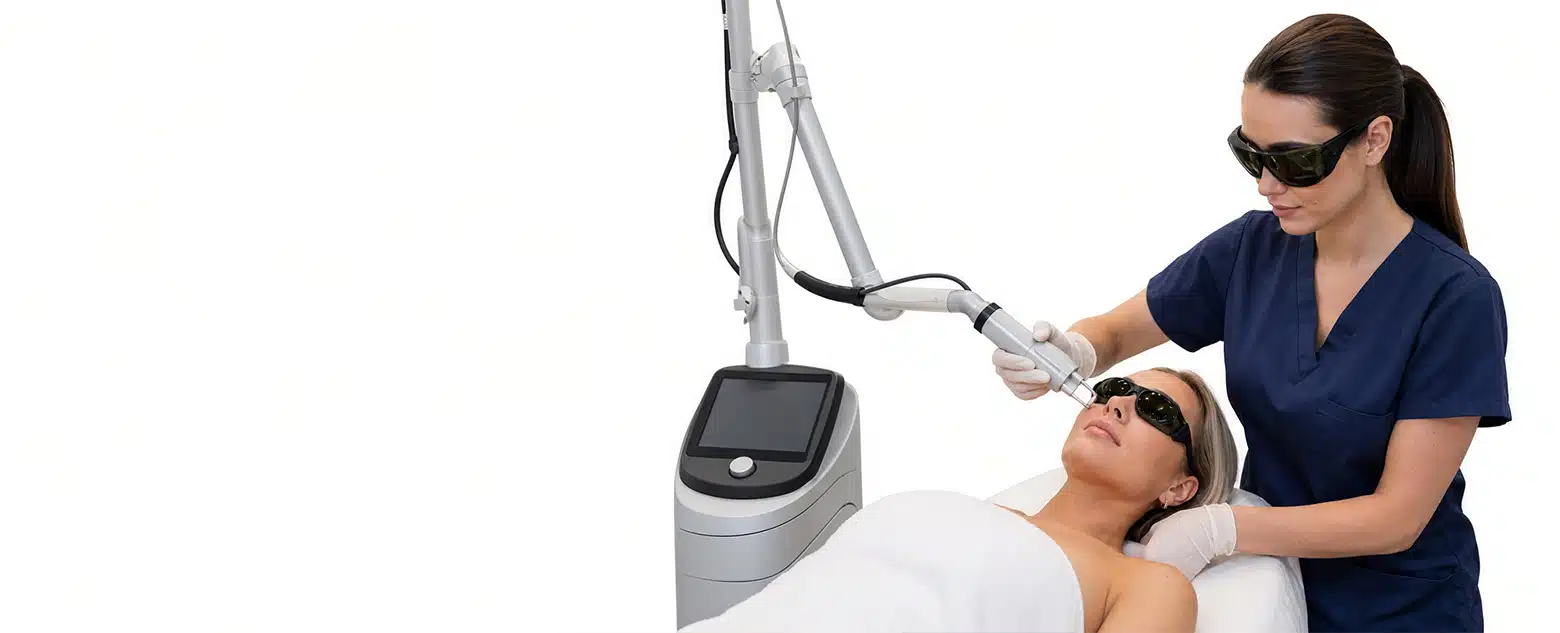
Build a practical understanding of how CO₂ resurfacing works—from laser-tissue interaction and fractional delivery to patient assessment, safety, healing, and treatment workflow, all in a flexible online format.
This self-paced online training brings the core concepts of CO₂ resurfacing into one focused learning experience. Students study the 10,600 nm wavelength, how laser energy interacts with water in tissue, fractional and ablative treatment principles, patient selection, safety, healing, downtime, and treatment workflow. It is also included within AML’s Advanced Laser Aesthetics Certification.
Understand how 10,600 nm CO₂ laser energy interacts with water-containing skin tissue.

Compare tissue removal, thermal injury, downtime, healing, and treatment goals.

Learn how microthermal treatment zones support controlled resurfacing and recovery.

Review consultation, contraindications, risk awareness, test spots, and safer planning.

Follow a practical demonstration of controls, treatment patterns, workflow, and aftercare.

CO₂ laser resurfacing uses a wavelength of approximately 10,600 nanometers, which is strongly absorbed by water in the skin. This interaction allows the laser to precisely heat, vaporize, or ablate targeted tissue while creating a controlled thermal response.
The course explains how this controlled injury activates wound healing, collagen remodeling, and new tissue formation. Students learn the difference between removing tissue and creating thermal coagulation, and why treatment depth, density, energy, and delivery method matter.

One of the most important concepts in resurfacing is understanding the difference between ablative and non-ablative technology. CO₂ is an ablative laser because it can remove microscopic columns of tissue, while non-ablative fractional devices create controlled thermal injury without physically removing the surface in the same way.
This section compares the clinical concepts that matter most: tissue interaction, recovery, visible skin response, treatment intensity, and the types of concerns each technology may be used to address.

Successful CO₂ resurfacing begins before the laser is activated. Students review consultation, skin assessment, treatment goals, contraindications, healing expectations, and risk factors that may influence whether a patient is an appropriate candidate.
The course also reinforces the importance of eye protection, plume management, treatment-room safety, conservative test spots, documentation, and following the operating instructions and protocols for the specific device being used.
See a practical CO₂ laser demonstration covering the treatment interface, pattern selection, treatment-area sizing, scan modes, workflow, testing, and post-treatment steps. The demonstration is designed as a general educational guide rather than training for one specific manufacturer.
Every CO₂ laser platform is different. Energy ranges, pulse characteristics, handpieces, software, treatment modes, and recommended settings vary by brand and model. Manufacturers commonly provide device-specific training so operators understand the correct settings and protocols for the equipment they use.
This CO₂ Laser Resurfacing Training Course is included as part of AML Laser Academy’s Advanced Laser Aesthetics Certification, allowing students to study CO₂ resurfacing alongside laser hair removal, IPL, tattoo removal, radiofrequency, photofacial technology, and laser safety.
For professionals and clinic teams looking for broader laser education, the Advanced Laser Course provides a more complete training pathway while including the CO₂ resurfacing material presented on this page.
The training is built for professionals, students, and clinic teams who want a stronger understanding of CO₂ resurfacing before, during, or after device-specific manufacturer training. It can be useful for practices that already use CO₂ technology, teams evaluating a new platform, and students completing AML’s broader Advanced Laser Aesthetics Certification.
Because CO₂ systems vary by brand and model, the course does not present one machine’s settings as universal. Instead, it teaches concepts that transfer across platforms: laser-tissue interaction, treatment depth and density, fractional delivery, patient assessment, contraindications, safety, recovery, and treatment planning.
Important: Online education does not independently authorize a person to perform CO₂ laser procedures. Legal scope of practice, supervision requirements, hands-on competency, and device-specific training vary by jurisdiction, employer, facility, and laser manufacturer.
Explore the focused CO₂ laser resurfacing curriculum, from foundational laser physics and fractional delivery through patient assessment, treatment planning, safety, healing, downtime, treatment demonstration, and final review.
This course provides a structured introduction to CO₂ resurfacing technology and the practical concepts professionals need to understand before working with a specific device. It is educational training and does not replace manufacturer instruction, supervision requirements, or state-specific scope-of-practice rules.
This course is intended for students and professionals seeking a stronger educational foundation in CO₂ resurfacing technology. Depending on jurisdiction, operating an ablative laser may require specific professional licensure, medical supervision, facility requirements, or device-specific training.
Always follow applicable laws, your facility’s policies, the manufacturer’s instructions for use, and training requirements for the exact CO₂ laser platform being operated.

CO₂ resurfacing is an ablative skin-resurfacing technology that uses light at approximately 10,600 nm. Because this wavelength is strongly absorbed by water in tissue, it can create controlled ablation and thermal effects that support skin renewal and collagen remodeling.
Water is the primary chromophore for CO₂ energy at approximately 10,600 nanometers. That strong absorption allows the laser to create controlled vaporization, ablation, and coagulation in water-containing tissue.
Yes. CO₂ technology is considered ablative because it can vaporize and remove targeted tissue. Fractional systems deliver that effect in microscopic treatment zones while leaving intervening areas untreated.
Fractional delivery creates microscopic treatment columns instead of treating every point of the skin surface uniformly. The untreated tissue between those columns can support healing while the treated areas create controlled resurfacing and thermal stimulation.
Ablative resurfacing removes targeted tissue, while non-ablative technology primarily creates controlled thermal injury without removing the epidermal surface in the same way. The approaches differ in tissue interaction, recovery, and treatment intensity.
Students study CO₂ laser physics, the 10,600 nm wavelength, fractional and ablative resurfacing, laser-tissue interaction, patient assessment, contraindications, treatment-planning concepts, safety, healing, downtime, aftercare, risks, complications, and treatment workflow.
It is designed for professionals, students, and clinic teams seeking a stronger educational foundation in CO₂ resurfacing. Eligibility to perform treatment depends on applicable laws, professional scope, supervision, workplace requirements, and device-specific competency.
Yes. The training includes a general demonstration covering the treatment interface, pattern selection, treatment-area sizing, scan modes, test-spot concepts, workflow, and post-treatment steps. It is educational and is not specific to one manufacturer.
Yes. Students review typical post-treatment responses, skin-barrier recovery, redness, swelling, crusting, peeling, healing stages, aftercare considerations, and why recovery can vary with treatment depth, density, device, and protocol.
No single setting applies to every device. Platforms differ by manufacturer, pulse characteristics, power, scanner, handpiece, software, and treatment mode. The training teaches general principles; providers should complete manufacturer-specific instruction for the exact equipment they use.
No. This course provides device-neutral education, but it does not replace the manufacturer’s operating instructions, device-specific training, hands-on competency requirements, employer protocols, or jurisdiction-specific requirements.
Yes. This CO₂ resurfacing training is included within AML Laser Academy’s Advanced Laser Aesthetics Certification program.
Yes. The lessons are delivered online and can be completed at the student’s own pace, with the ability to revisit the educational material as needed.
Study CO₂ laser physics, fractional resurfacing, ablative treatment principles, safety, recovery, patient selection, and treatment demonstration in one focused online course.