Updated June 2026 • Physician-Reviewed Buying Guide

Top 10 Best Aesthetic Laser Machines for Med Spa (2026 Physician Review & Buying Guide)

Compare leading aesthetic laser, IPL, radiofrequency, resurfacing, hair-reduction, and tattoo-removal platforms—plus the safety, training, service, and financial questions every med spa should evaluate before purchasing.

10 leading companies reviewed 5 core treatment categories Current official manufacturer links Buying and training checklist
Medical review: Dr. Leo Capobianco, DO, FAAEM Educational comparison—not a substitute for manufacturer documentation, legal advice, or state-specific scope-of-practice guidance.
10Leading CompaniesManufacturers and technology distributors compared
5Treatment CategoriesHair, skin, vascular, body, and tattoo applications
2026Current ReviewBrand links and positioning checked for this update
Safety FirstTraining, oversight, service, and protocol readiness included
The question med spa owners ask most
“What are the best aesthetic laser machines for med spa practices right now?”

The answer is not one universal brand. The right choice depends on your intended treatments, patient demographics, staff qualifications, supervision structure, budget, room requirements, service support, and commitment to safe clinical protocols.

From a medical-director perspective, device selection is only one part of the outcome. Oversight, operator education, patient selection, maintenance, documentation, and disciplined parameter use matter just as much as the technology itself.

Fast Comparison

At a Glance: Top 10 Aesthetic Laser Machines for Med Spa – 2026 Physician Comparative Matrix

Finding the best aesthetic laser machines for your med spa requires matching technology to your clinical goals. The matrix below is a directional comparison of where each company has notable current offerings—not a universal ranking and not a statement that every model includes every capability.

Important: Product configurations, regulatory clearances, included handpieces, warranties, prices, and availability vary by country and can change. Always verify the exact quoted system with the manufacturer or authorized distributor.
2026 comparison of leading aesthetic laser companies by hair reduction, IPL, resurfacing, tightening, and tattoo-removal capabilities.
Company Laser Hair Reduction IPL / Rejuvenation Skin Resurfacing Tightening / Body Tattoo / Pigment
Candela MedicalNotableAvailableAvailableAvailableNotable
LumenisNotableNotableNotableAvailableAvailable
ScitonAvailableNotableNotableAvailablePortfolio dependent
El.En. / DEKA / QuantaNotableAvailableNotableAvailableNotable
Alma LasersNotableAvailableAvailableNotableAvailable
CynosureNotableAvailableNotableNotableNotable
CuteraNotableAvailableNotableNotableNotable
InModeAvailableNotableNotableNotableAvailable
VenusAvailableNotableAvailableNotablePortfolio dependent
Cartessa AestheticsPortfolio dependentPortfolio dependentPortfolio dependentPortfolio dependentPortfolio dependent
Evaluation Framework

What Defines the Best Aesthetic Laser Machines for Med Spa Practices?

Aesthetic equipment should be assessed beyond brand recognition and marketing language. The strongest fit is a platform that can deliver controlled, repeatable energy for the intended indication while supporting safe operation, realistic patient comfort, reliable maintenance, and a sustainable business model.

Energy ConsistencyStable pulse delivery and repeatable output across treatments.
Wavelength & Pulse ControlParameters suited to target depth, chromophore, and skin type.
Cooling & SafeguardsEpidermal protection, sensing, cutoffs, and clear alerts.
Clinical VersatilityUseful—not merely advertised—applications for your patient base.
Training & SupportStructured onboarding, protocols, service, and continuing education.
Total Cost of OwnershipFinancing, consumables, maintenance, downtime, and upgrade costs.
Regulatory StatusApplicable FDA clearance or other jurisdiction-specific authorization.
Workflow FitRoom, electrical, ventilation, staffing, scheduling, and documentation needs.

Laser and energy-based devices demand precision and structured education. A formal Laser Safety Officer course can help a practice build stronger controlled-area procedures, eyewear protocols, documentation, incident readiness, and safety oversight.

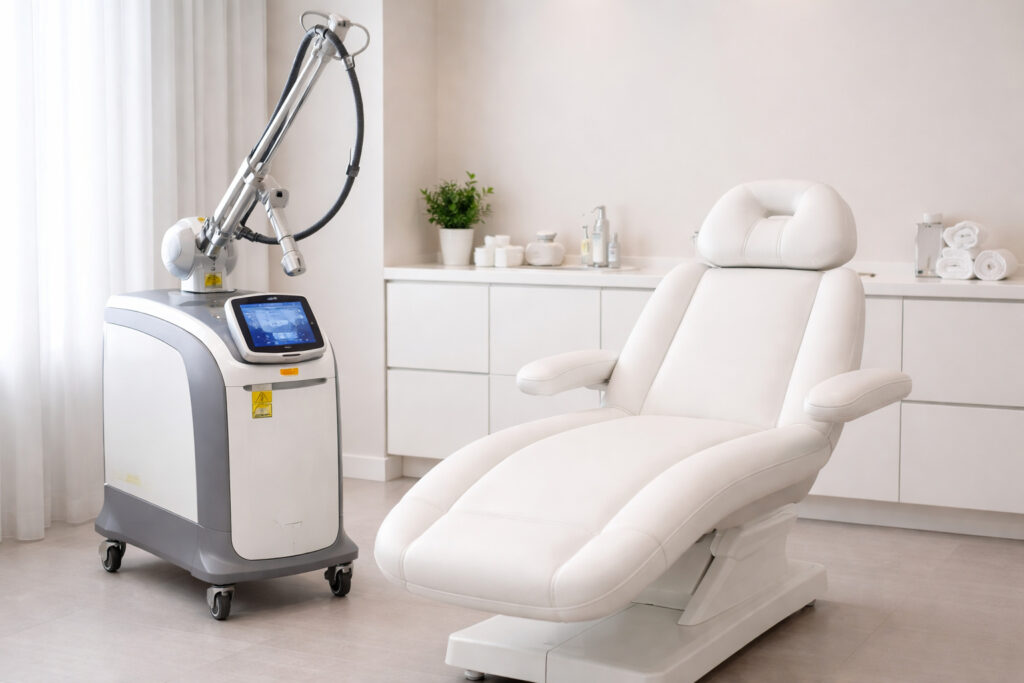
Class IV medical laser device in a professional med spa treatment room with laser safety controls
The device, room, staff, documentation, maintenance plan, and safety program must work as one clinical system.
Treatment Planning

Core Treatment Categories Every Med Spa Should Master

A med spa does not need every technology on day one. It needs a deliberate service strategy, qualified operators, appropriate medical oversight, and equipment that matches the treatments the practice can safely and legally provide.

Practitioner using an aesthetic laser machine for professional hair removal treatment on a patient’s leg
Alexandrite • Nd:YAG • Diode

1. Laser Hair Removal

Laser hair removal remains a foundational service for many medical spas. Common technologies include Alexandrite (755 nm), Nd:YAG (1064 nm), and diode wavelengths commonly centered around 800–810 nm.

A dual-wavelength platform can give a practice greater flexibility across eligible skin types. Nd:YAG is especially important when treating darker skin tones because it penetrates more deeply and is less strongly absorbed by epidermal melanin than shorter wavelengths. Safe, effective treatment still depends on appropriate fluence, pulse duration, spot size, cooling, patient selection, and operator training.

Clinician performing professional laser skin resurfacing for facial rejuvenation in a medical aesthetic setting
CO₂ • Erbium • Non-Ablative

2. Skin Rejuvenation & Skin Resurfacing

Skin rejuvenation and laser skin resurfacing can address texture, photodamage, selected pigmented lesions, wrinkles, and acne-scar concerns. Ablative CO₂ and erbium systems remove or vaporize tissue at controlled depths, while non-ablative technologies heat targeted tissue with less surface disruption and generally less downtime.

The appropriate platform depends on the practice’s treatment philosophy, patient population, desired downtime, and ability to manage pre-care and post-care. Underpowered treatment may produce limited improvement, while aggressive parameters without appropriate oversight can increase complication risk. Review the protocols covered in AML’s Advanced Laser Aesthetics course.

Professional IPL treatment for pigmentation and vascular concerns performed in a med spa treatment room
IPL • 532 nm • 1064 nm

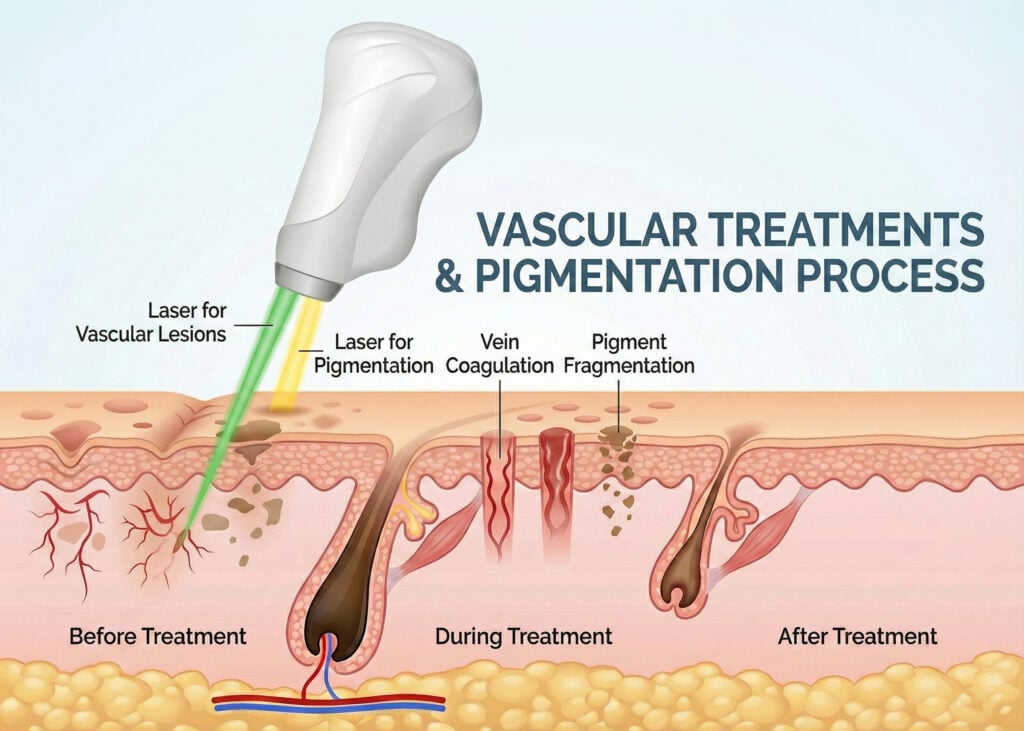
3. Vascular Treatments & Pigmentation

Vascular and pigment work requires careful matching of wavelength, filter, pulse structure, fluence, cooling, and target depth. IPL systems can be versatile for photorejuvenation, diffuse redness, and selected pigment concerns, while dedicated vascular lasers may offer greater specificity for particular vessels or depths.

Improper settings can increase the risk of burns, blistering, dyspigmentation, or inadequate results. Practices should evaluate whether a platform offers the filters, pulse control, cooling, and treatment guidance needed for the conditions they intend to treat. AML’s Intense Pulsed Light course covers foundational IPL principles and safety.

Professional radiofrequency aesthetic platform used for skin tightening and body contouring services
RF • RF Microneedling • Body Systems

4. Skin Tightening & Body Contouring

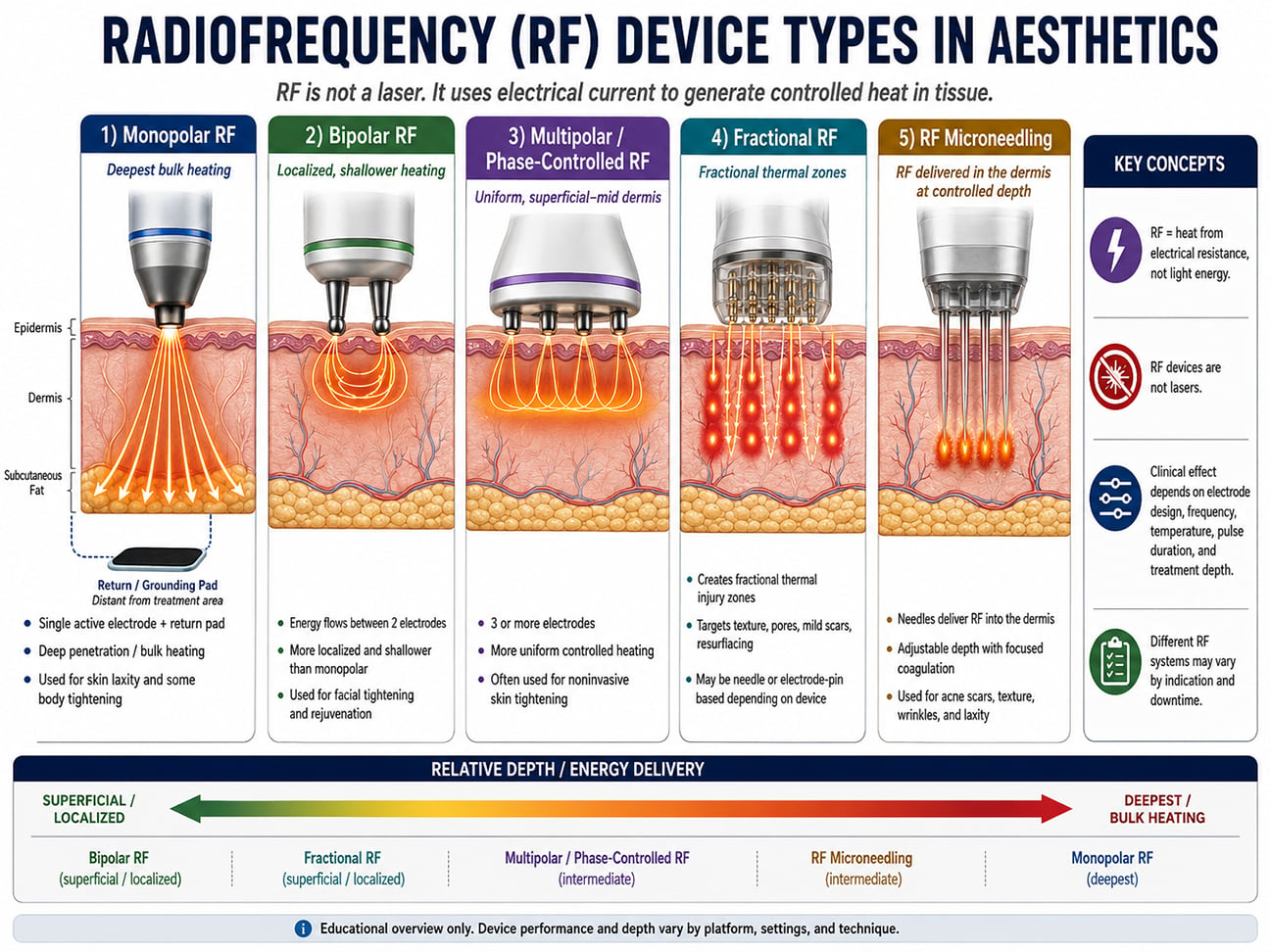
Radiofrequency-based devices use controlled tissue heating to support collagen remodeling, skin tightening, wrinkle reduction, and selected body-contouring applications. Technologies may include monopolar RF, bipolar RF, multipolar RF, fractional RF, and RF microneedling.

Useful safety features can include temperature monitoring, impedance feedback, contact sensing, energy-delivery controls, and automatic cutoffs. Because heat can accumulate quickly, operators must understand endpoints, treatment overlap, contraindications, and patient feedback. Explore these concepts in AML’s Radiofrequency Master Course.

Professional laser tattoo removal machine used in a clinical setting for pigment and ink removal treatments
Picosecond • Q-Switched • Multi-Wavelength

5. Tattoo Removal

Tattoo removal commonly relies on picosecond or Q-switched laser technology to fragment tattoo pigment through short pulses and a strong photoacoustic or photomechanical effect. Different ink colors may require different wavelengths, and response varies with ink composition, depth, density, age, location, and patient skin type.

The strongest platforms provide precise parameter control, suitable wavelength options, consistent beam delivery, and cooling support. Safe treatment also requires realistic expectations, appropriate test spots when indicated, careful interval planning, and clear protocols for reducing the risk of scarring, hypopigmentation, and hyperpigmentation.

Company-by-Company Review

2026 Clinical Review: Best Aesthetic Laser Machines for Med Spa

Clinical reliability, treatment versatility, safety features, training support, service coverage, and total cost all matter. The companies below are reviewed by practical strengths rather than treated as interchangeable “all-in-one” solutions.

i

Pricing disclosure: The investment figures below are broad editorial estimates retained from the original guide. They are not manufacturer quotes and may exclude handpieces, shipping, installation, training, financing charges, consumables, extended warranties, or service plans. Request a written, itemized proposal before making a decision.

El.En. DEKA and Quanta aesthetic laser platform shown in a professional medical aesthetic environment

1. El.En. S.p.A. (DEKA / Quanta)

Clinical focusMixed laser platforms, CO₂ resurfacing, pigment and tattoo systems
Broad estimate$70,000–$150,000

El.En. Group includes medical-aesthetic brands and companies such as DEKA and Quanta System. Across the broader portfolio, practices can find platforms for hair reduction, resurfacing, pigment work, vascular applications, and tattoo removal.

DEKA is especially well known for CO₂-based technologies, while Quanta has a broad laser portfolio that includes multi-wavelength systems. Because models and indications differ by market, buyers should compare the exact handpieces, wavelengths, clearances, training package, and service structure included with the quoted configuration.

Visit official manufacturer website
Lumenis aesthetic laser and light-based platform used in a professional medical spa clinic

2. Lumenis

Clinical focusMulti-application platforms, IPL, hair removal, CO₂ and RF
Broad estimate$70,000–$140,000

Lumenis offers a broad portfolio that includes IPL, diode hair-removal systems, Alexandrite/Nd:YAG platforms, CO₂ lasers, and radiofrequency technologies. Systems such as the Stellar M22 are frequently considered by clinics seeking a modular platform for photorejuvenation, pigment, vascular, and other applications.

The main purchasing advantage is breadth, but the final capability depends on the modules included. Confirm which handpieces and technologies are part of the quote, which indications are cleared in your jurisdiction, and whether future modules can be added without replacing the base platform.

Visit official manufacturer website
Candela Medical aesthetic laser machine displayed in a med spa treatment environment

3. Candela Medical

Clinical focusHair reduction, vascular treatments, pigment and tattoo platforms
Broad estimate$65,000–$130,000

Candela’s Gentle platform is widely used for laser hair reduction and combines 755 nm Alexandrite and 1064 nm Nd:YAG options in selected models. That pairing can support treatment planning across a broad range of eligible skin types when used by appropriately trained professionals.

Candela also markets vascular, pigment, resurfacing, RF microneedling, and picosecond systems. Practices comparing Candela should evaluate cooling method, spot-size options, pulse-duration range, throughput, service response, consumables, and whether the selected device fits the clinic’s most frequent indications.

Visit official manufacturer website
Alma Lasers aesthetic platform used for professional skin and hair treatments in a med spa clinic

4. Alma Lasers

Clinical focusDiode hair removal, hybrid platforms, body and skin technologies
Broad estimate$60,000–$135,000

Alma offers a diverse portfolio spanning hair removal, skin rejuvenation, resurfacing, vascular and pigmented-lesion applications, body contouring, and RF-based treatments. Its Soprano family is strongly associated with diode hair reduction, while Harmony and other platforms support broader treatment menus.

The breadth can be attractive to a growing practice, but buyers should compare the exact applicators and technologies included rather than relying on the platform name alone. Service coverage, training, consumable costs, upgrade paths, and the expected utilization of each handpiece should be part of the decision.

Visit official manufacturer website
Cutera aesthetic laser device used in a medical spa for professional skin and laser procedures

5. Cutera

Clinical focusVascular and pigment lasers, hair removal, acne and body systems
Broad estimate$55,000–$110,000

Cutera’s current portfolio includes vascular and pigment platforms, hair-removal systems, multi-application workstations, acne technology, tattoo and pigment systems, RF microneedling, and body-contouring devices. Its 532/1064 nm vascular platforms are a notable part of the brand’s clinical identity.

For a med spa, Cutera can be attractive when the service mix extends beyond one treatment category. Compare the exact model’s indication list, cooling, handpieces, repetition rate, service contract, room requirements, and expected patient demand before deciding whether a focused or multi-application system is the better fit.

Visit official manufacturer website
Cynosure aesthetic laser system shown in a professional med spa treatment setting

6. Cynosure

Clinical focusPicosecond pigment systems, RF, hair removal and resurfacing
Broad estimate$60,000–$125,000

The company now presents itself as Cynosure Lutronic and markets laser and RF technologies across hair removal, pigment, tattoo, resurfacing, vascular, and skin-tightening applications. PicoSure Pro remains one of the brand’s recognizable picosecond platforms.

Practices should compare wavelength options, pulse characteristics, spot sizes, cooling, handpieces, and the exact indications cleared for each model. Picosecond technology can be valuable for tattoo and pigment work, but outcomes still depend on appropriate wavelength selection, conservative parameter progression, and careful management of skin-type risk.

Visit official manufacturer website
Sciton aesthetic laser platform used for professional skin rejuvenation and resurfacing treatments

7. Sciton

Clinical focusBroadBand Light, erbium resurfacing and modular skin platforms
Broad estimate$80,000–$140,000

Sciton is strongly associated with BroadBand Light and modular platforms that support photorejuvenation, vascular and pigment applications, hair reduction, and erbium-based resurfacing. Its portfolio includes treatments and handpieces such as BBL, HALO, MOXI, ProFractional, and ClearV.

Sciton systems can be a strong fit for practices centered on skin quality and resurfacing, particularly when multiple compatible handpieces will be used consistently. Buyers should compare the base system, included modules, upgrade path, training, service response, and the revenue potential of the specific applications they plan to launch.

Visit official manufacturer website
InMode medical aesthetic platform used for radiofrequency skin and body treatments

8. InMode

Clinical focusRadiofrequency, RF microneedling, body, skin and hair technologies
Broad estimate$75,000–$150,000

InMode’s portfolio is heavily associated with radiofrequency, RF microneedling, minimally invasive RF-assisted procedures, body platforms, IPL, vascular technology, and hair removal. Current workstation configurations can combine multiple technologies within one ecosystem.

Because RF devices can deliver substantial thermal energy, training should include tissue endpoints, temperature management, overlap, contraindications, emergency procedures, and post-treatment care. Buyers should also distinguish between non-invasive, minimally invasive, and procedure-specific handpieces because staffing, supervision, and scope-of-practice requirements may differ.

Visit official manufacturer website
Venus medical aesthetic device used for professional skin tightening and body-contouring treatments

9. Venus Concept

Clinical focusMultipolar RF, PEMF, IPL, resurfacing and body technologies
Broad estimate$60,000–$120,000

Venus now directs its primary corporate website through Venus.ai. The portfolio includes devices for body treatments, skin tightening, photorejuvenation, hair removal, resurfacing, cellulite reduction, and other aesthetic applications.

Venus platforms may appeal to practices that prioritize non-invasive services, patient comfort, and multi-treatment workflows. Compare the exact technology mix—such as RF, pulsed electromagnetic fields, IPL, resurfacing, or muscle stimulation—along with training, consumables, support, and the indications cleared for the model being considered.

Visit official manufacturer website
Cartessa Aesthetics medical device displayed for professional aesthetic treatment applications

10. Cartessa Aesthetics

Clinical focusCurated aesthetic technologies from multiple global manufacturers
Broad estimate$65,000–$135,000

Cartessa Aesthetics is an independent aesthetic-technology company and distributor rather than a single-platform manufacturer. Its portfolio spans laser resurfacing, hair removal, RF, body treatments, pigment and vascular applications, tattoo removal, hydrodermabrasion, and skin analysis.

The independent portfolio can help a practice compare specialized devices without staying within one manufacturer ecosystem. The tradeoff is that service, consumables, training, and technology origins may vary by product. Review each device individually and use the official Cartessa Aesthetics domain—not the unrelated Cartessa.com electronics website.

Visit official manufacturer website
Capital Equipment Checklist

Strategic Buying Considerations for Med Spa Owners

A smart equipment purchase is not simply the device with the longest indication list. It is the system that fits your patients, scope of practice, staffing model, utilization forecast, clinical standards, and long-term financial plan.

Patient DemandUse consultation and treatment data—not assumptions—to identify the strongest local opportunities.
Scope & SupervisionConfirm who may operate the device and what medical supervision is required in your state.
Exact ConfigurationList every wavelength, handpiece, filter, spot size, tip, and software feature included.
Service ResponseAsk about preventive maintenance, loaners, technician coverage, uptime guarantees, and parts.
Consumables & WarrantyCalculate tips, cartridges, lamps, fibers, cooling supplies, warranties, and annual service.
Training PackageSeparate device orientation from independent education in physics, safety, complications, and protocols.
Facility ReadinessConfirm electrical, room, ventilation, plume, controlled-area, eyewear, signage, and storage needs.
Financial Stress TestModel conservative utilization, downtime, staffing, financing, marketing, and treatment pricing.

Many growing practices begin with a dependable hair-reduction platform, then add IPL or a vascular/pigment system and a radiofrequency service based on patient demand. Resurfacing, tattoo removal, and advanced body technologies can follow when the team, room, protocols, and medical oversight are ready.

The machine alone does not create success. Consistent outcomes come from structured training, appropriate patient selection, parameter discipline, maintenance, documentation, complication readiness, and realistic client expectations.

Med spa owner evaluating a professional aesthetic laser machine before a capital equipment purchase
Clinical Category Standouts

Physician’s 2026 Clinical Recommendations by Treatment Category

These are practical category observations, not universal winners, endorsements, or guarantees. The best platform still depends on the exact model, configuration, patient population, operator qualifications, and practice goals.

01High-Volume Hair Reduction

Candela remains a common benchmark because selected Gentle platforms combine Alexandrite and Nd:YAG wavelengths with established cooling and high-throughput workflows. Lumenis, Alma, Cutera, Cynosure, and other companies also offer strong hair-reduction options that should be compared model by model.

02IPL, Rejuvenation & Resurfacing

Lumenis and Sciton remain important comparisons for practices building around IPL, vascular/pigment work, photorejuvenation, and resurfacing. Alma, Cutera, Candela, El.En./DEKA, Cartessa-distributed systems, and others may be stronger fits depending on the desired modality and workflow.

03Tattoo & Pigment Removal

Cynosure Lutronic, Candela, Cutera, Quanta, Alma, and selected Cartessa-distributed platforms are among the companies a buyer may evaluate for picosecond, Q-switched, and multi-wavelength pigment applications. Compare wavelength access, pulse characteristics, clinical support, and skin-type protocols.

From Purchase to Safe Operation

Implementing 2026 Clinical Standards in Your Practice

Selecting the right aesthetic laser machine is only one component of building a successful med spa. Sustainable performance depends on standardized training, documented safety procedures, preventive maintenance, clear delegation, and disciplined protocol execution.

AML Laser Academy provides structured online education for aesthetic clinics and med spa teams, including:

Laser Safety Officer (LSO) Certification
Advanced Laser Hair Removal Training
Intense Pulsed Light (IPL) Certification
Radiofrequency & Skin Tightening Programs
Tattoo Removal Fundamentals
Clinical Documentation & Compliance Frameworks

Our curriculum supports centralized onboarding, stronger risk-management practices, and scalable education for growing aesthetic teams. Training does not replace state licensing, required supervision, manufacturer device instruction, or hands-on competency requirements where applicable.

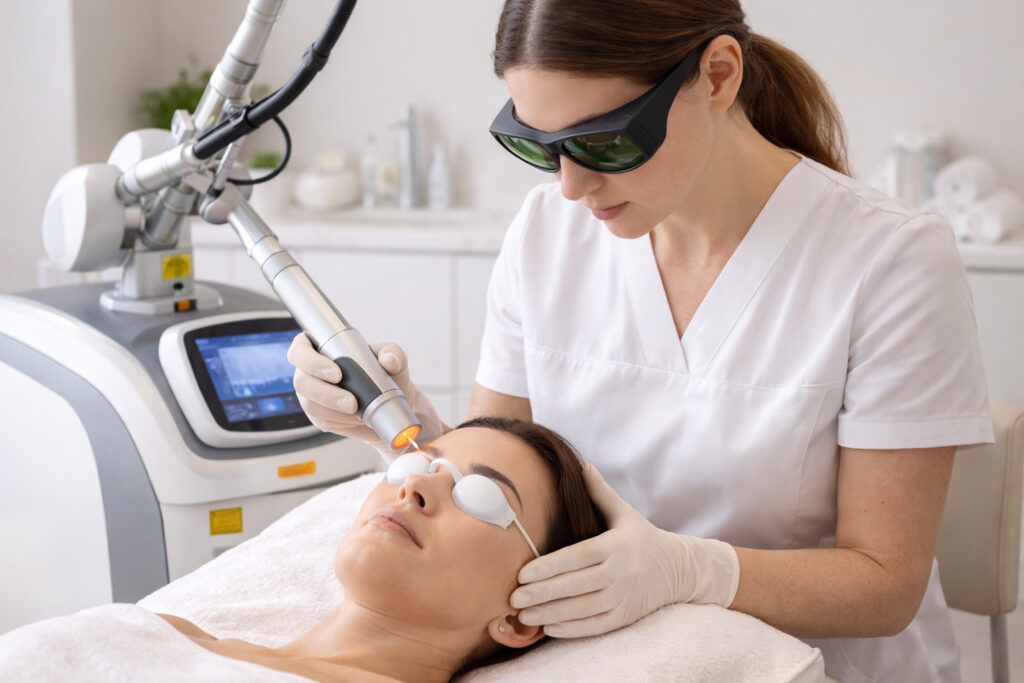
Laser practitioner wearing protective eyewear during a medical laser procedure in a controlled treatment area
Quick Answers Before You Purchase
What aesthetic device should a new med spa buy first?

Start with the service that has demonstrated local demand, fits your legal scope and staffing, and can support conservative utilization. Hair reduction is common, but the best first purchase may instead be IPL, vascular technology, RF, or another focused platform.

How much does a professional aesthetic laser machine cost?

New professional systems can range from tens of thousands of dollars to well above $150,000 depending on technology, handpieces, modules, warranty, training, financing, and service. Obtain itemized quotes and calculate total ownership cost rather than comparing base price alone.

Is IPL the same as a laser?

No. IPL uses a broad spectrum of filtered light, while a laser emits a more specific wavelength or narrow wavelength range. Both are energy-based technologies and require appropriate training, patient selection, eye protection, and procedural controls.

Can one platform safely treat every skin type and indication?

No single configuration is ideal for every patient, target, and treatment. Safe use depends on the device’s wavelengths and pulse characteristics, the patient’s skin type and condition, operator competency, and the specific indication cleared for that platform.

Does manufacturer training replace laser safety education?

Manufacturer instruction is essential for the specific device, but it may focus mainly on operation and treatment protocols. A complete program should also address laser physics, hazard controls, eyewear, controlled areas, plume, documentation, emergencies, and the Laser Safety Officer role.

Should a clinic buy new, refurbished, or used equipment?

Any option requires due diligence. Verify title and ownership, serial number, service history, software status, remaining shot counts where relevant, parts availability, calibration, warranty transferability, regulatory status, installation requirements, and whether the manufacturer will support the unit.

Prepare your team before the device arrives.

Build a stronger foundation in laser safety, IPL, hair reduction, radiofrequency, tattoo removal, and clinical documentation with AML Laser Academy’s online curriculum.

View AML Laser Academy Courses