
Advanced Laser Aesthetics Certification
Comprehensive professional education in laser safety, IPL, hair reduction, tattoo removal, radiofrequency, treatment planning, and aesthetic technology principles.
View Advanced CertificationUnderstand Texas laser hair removal certification, physician-led cosmetic laser pathways, facility requirements, safety responsibilities, and professional online education for medical and aesthetic teams.
Texas offers valuable career and business opportunities for physicians, nurses, medical directors, laser professionals, medical spa teams, dermatology practices, and aesthetic clinic owners. The correct legal pathway depends on the treatment, device, provider credentials, facility structure, and whether the service is delivered through a registered laser hair removal facility or a physician-led medical practice.
This guide explains both pathways while showing how professional laser education can benefit physicians, nurses, medical directors, medical spas, laser technicians, and entire clinic teams.
AML Laser Academy provides advanced online education in cosmetic laser theory, treatment principles, skin science, patient safety, and professional responsibilities. The courses are especially valuable for physicians, nurses, medical directors, laser professionals, and clinic teams seeking stronger knowledge, more consistent protocols, and confident preparation for clinical and device-specific training.
Navigating Texas laser regulations can be confusing because different agencies oversee different parts of the industry.
TDLR regulates the Texas laser hair removal certification and facility system.
The Texas Medical Board and other professional boards address medical practice, professional scope, and physician delegation.
DSHS regulates covered laser devices, radiation safety, and Laser Safety Officer responsibilities.
AML Laser Academy provides professional online laser education designed to help individuals and clinic teams better understand cosmetic laser technology, treatment principles, skin science, patient safety, professional responsibilities, and laser safety.
Texas separates non-ablative laser hair removal, governed by TDLR under Texas Health and Safety Code Chapter 401, Subchapter M, from medical and cosmetic laser procedures overseen through DSHS and professional medical boards. Understanding which pathway applies is essential before enrolling in a program or submitting an application.
The Texas Department of Licensing and Regulation issues individual laser hair removal certificates at four levels. The progression below summarizes the entry requirements, clinical experience, and supervision framework.
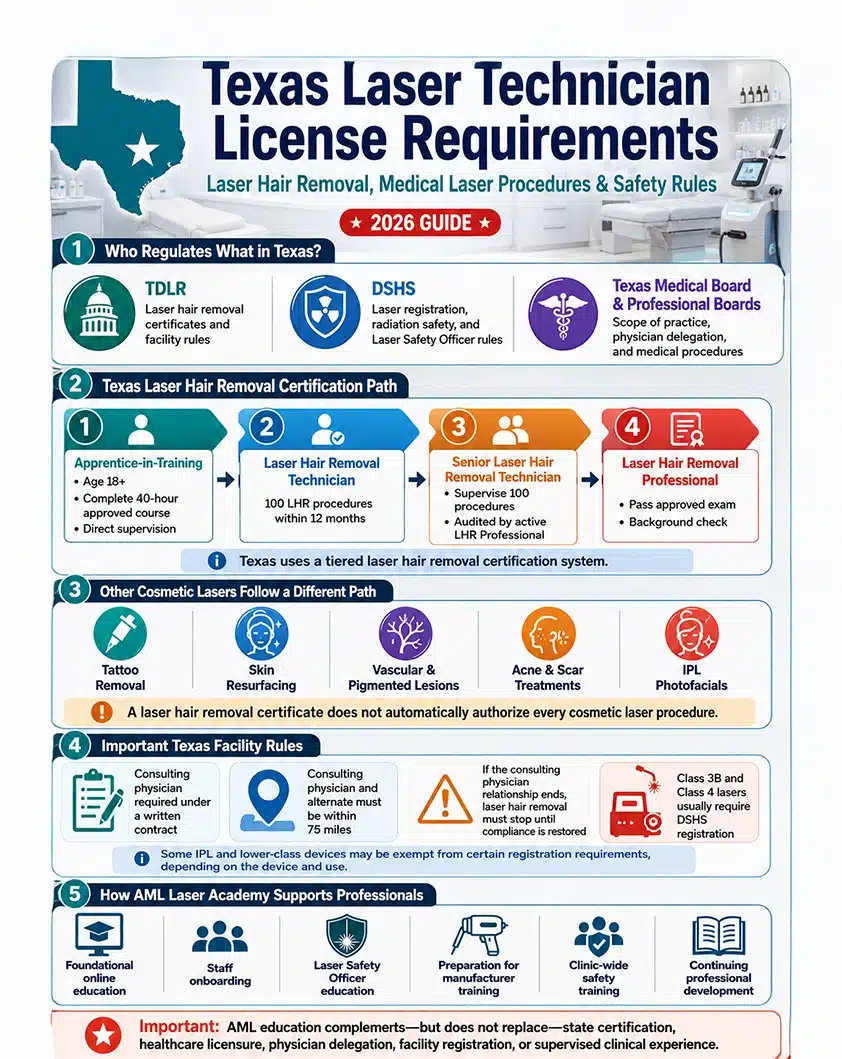
The Texas Department of State Health Services regulates radiation safety for lasers and intense pulsed light devices. Businesses using Class 3B and Class 4 lasers generally must obtain the applicable DSHS certificate of laser registration. Texas regulations also establish safety requirements addressing hazards, operator qualifications, written procedures, protective equipment, controlled areas, records, and Laser Safety Officer responsibilities.
Businesses that possess or use covered Class 3B or Class 4 lasers generally need the applicable DSHS certificate of laser registration and must satisfy the requirements attached to that registration.
Under 25 TAC §289.301, Class 1, Class 2, FDA Class 3a, IEC Class 3R lasers, and IPL devices are not required to be registered under the specified provisions. Their use may still be subject to safety rules, professional scope, medical-practice requirements, and physician delegation.
DSHS device registration is separate from TDLR laser hair removal personnel certification and TDLR laser hair removal facility registration.
Depending on the device, treatment purpose, professional personnel, and practice structure, physician-led medical cosmetic procedures may include:
The exact legal and regulatory requirements should be evaluated separately for each procedure. A Texas laser hair removal certificate should not be treated as automatic authority to perform tattoo removal, ablative resurfacing, vascular treatments, lesion treatments, or every IPL procedure.
For delegated nonsurgical medical cosmetic procedures, Texas Medical Board Chapter 169, Subchapter E states that a physician, physician assistant, or advanced practice registered nurse must be onsite during the procedure or immediately available for emergency consultation. When necessary, the physician must also be able to conduct an emergency appointment with the patient.
Physicians, medical directors, nurses, nurse practitioners, physician assistants, and medical assistants can use AML Laser Academy courses to strengthen their understanding of laser and IPL technology, treatment planning, skin assessment, contraindications, patient safety, documentation, adverse-event awareness, and clinic-wide laser safety.
This education is valuable for professionals entering medical aesthetics, expanding an existing practice, supervising aesthetic services, onboarding employees, supporting a Laser Safety Officer, or building more consistent protocols across one or multiple locations. Each professional should continue to work within the scope, delegation, facility, and competency requirements that apply to the role and procedure.
A Texas esthetician license alone does not authorize laser hair removal or medical cosmetic laser procedures. To operate a cosmetic laser legally, the individual must follow the applicable TDLR laser hair removal certification pathway or work under a lawful medical delegation structure when all professional, facility, supervision, and competency requirements are satisfied.
AML professional education can help estheticians build knowledge in laser science, radiation safety, skin assessment, contraindications, and treatment workflows while preparing for the separate Texas certification and hands-on requirements applicable to their career goals.

Important for the Apprentice-in-Training pathway: AML Laser Academy provides broad advanced laser, IPL, skin science, and safety education for medical and aesthetic professionals. Applicants following the standard TDLR Apprentice-in-Training pathway complete the separate state-accepted 40-hour prerequisite through a currently approved Texas provider.
A person entering the standard TDLR Apprentice-in-Training pathway must complete a 40-hour laser hair removal training program accepted by TDLR. Course format, scheduling, and tuition vary by provider. Students should verify that the provider is currently accepted by the state before relying on a course for their application.
The state-accepted program covers required subjects such as laser physics, safety, skin and hair anatomy, contraindications, eye protection, and applicable Texas rules. AML courses expand professional knowledge across cosmetic laser theory, IPL, treatment principles, skin science, patient assessment, safety systems, professional development, and preparation for supervised or device-specific clinical training.
A robust training curriculum should look beyond device buttons and help professionals understand the science, safety controls, patient-assessment principles, and risk-management responsibilities behind laser and IPL procedures.
Wavelengths, chromophores, selective photothermolysis, light-tissue interaction, pulse duration, fluence, and treatment principles.
Nominal Hazard Zones, wavelength-appropriate protective eyewear, warning signs, controlled areas, smoke-plume awareness, and emergency procedures.
Fitzpatrick skin typing, hair-growth cycles, treatment suitability, photosensitizing medications, medical history, and contraindication screening.
Clinical endpoints, burn prevention, adverse-event recognition, escalation, incident documentation, infection prevention, and post-treatment care.
Texas laser and laser hair removal operations may require a designated and qualified Laser Safety Officer. AML’s Laser Safety Officer course provides structured professional education covering:
Completion of an AML LSO course documents professional education. The facility or registrant remains responsible for selecting a properly qualified LSO and satisfying all applicable Texas requirements.

The application process depends on the certificate level being pursued. Applicants should:
Requirements, application forms, and fees may change. Confirm current information directly with TDLR before applying.
Businesses using Class 3B or Class 4 lasers generally must obtain the applicable DSHS certificate of laser registration. IPL and lower-class lasers may be exempt from specified registration provisions but remain subject to applicable safety, professional-scope, and medical-practice requirements.
Nonexempt facilities offering laser hair removal must obtain a TDLR laser hair removal facility certificate of registration under Chapter 118 and satisfy the applicable personnel, physician-contract, protocol, audit, safety, and recordkeeping requirements.
A qualified LSO responsible for applicable safety-program duties and facility laser-safety responsibilities.
A Texas-licensed physician under a written contract addressing protocols, audits, emergency consultation, and an alternate consulting physician.
A designated Laser Hair Removal Professional who satisfies the applicable TDLR requirements for the facility role.
Facility-registration exemptions exist for a physician-owned or physician-operated facility used for the practice of medicine, a licensed hospital, and a hospital-owned clinic. These facilities may still need DSHS laser registration for covered devices or uses.
The primary practice site of the consulting physician and the alternate consulting physician must be located within 75 miles of the registered laser hair removal facility. The written physician contract must address treatment protocols, facility audits, emergency consultation, and alternate coverage.
The designated consulting physician and alternate consulting physician must be Texas-licensed M.D.s or D.O.s. An APRN or PA may assist with delegated duties where permitted but cannot replace the required consulting or alternate physician role for a registered TDLR laser hair removal facility.
If a registered laser hair removal facility loses the services of its consulting physician, the facility must immediately stop performing laser hair removal procedures until a compliant contractual relationship is restored.
Many education programs focus only on one credential, device, or entry-level requirement. AML helps clinics access scalable education that supports compliance awareness, staff development, safer professional practices, and more consistent team knowledge.
Expand knowledge of aesthetic technologies, treatment planning, screening standards, risk management, emergency protocols, documentation, team oversight, and Laser Safety Officer support.
Build strong professional knowledge of light-tissue interaction, Fitzpatrick skin typing, contraindication assessment, patient safety, treatment workflows, and adverse-event recognition for aesthetic practice settings.
Develop a strong educational foundation in radiation safety, skin science, consultation, pre-care, post-care, contraindications, and physician-led aesthetic workflows.
Comprehensive professional education in laser safety, IPL, hair reduction, tattoo removal, radiofrequency, treatment planning, and aesthetic technology principles.
View Advanced CertificationSupplemental education in hair-growth cycles, skin typing, IPL principles, client consultation, contraindications, treatment planning, and safety.
View IPL Hair Removal CourseProfessional education in ink and pigment behavior, wavelength principles, treatment planning, healing, client consultation, risk awareness, and safety.
View Tattoo Removal CourseLaser classifications, controlled areas, eyewear, hazard awareness, safety programs, documentation, and workplace responsibilities.
View Laser Safety CourseCross-contamination prevention, sanitation, disinfection, PPE, hand hygiene, sharps awareness, and workplace compliance readiness.
View Infection Control CourseExposure control, PPE, sharps safety, regulated waste, post-exposure procedures, and professional documentation.
View Bloodborne Pathogens CourseWhether you work in Dallas, Houston, Austin, San Antonio, Fort Worth, El Paso, Corpus Christi, or another Texas community, professional laser education can support stronger technical knowledge, safer workplace practices, and more consistent clinic-team development. Treatment authority still depends on the applicable TDLR pathway, professional scope, physician delegation, facility structure, DSHS requirements, and device-specific competency.
Compare Texas with other jurisdictions in the Laser License Requirements by State guide.
To build a deeper understanding of compliance, clinical science, and safety operations, explore these professional topics:
Review ownership, clinical-control, delegation, physician-oversight, and professional-practice considerations before opening or reorganizing a Texas medical spa.
Understand daily safety-program responsibilities, documentation, controlled-area practices, staff training, incident response, and equipment oversight.
Build stronger knowledge of skin assessment, treatment planning, pigment risk, contraindications, clinical endpoints, and adverse-event prevention.
These answers provide general educational guidance. Texas requirements may differ according to the procedure, device, certificate level, professional license, delegation structure, facility, and current agency interpretation.
Generally, individuals performing laser hair removal need the appropriate TDLR certificate. Texas provides exemptions for Texas physicians, individuals properly delegated by a Texas physician, and licensed health professionals when laser hair removal falls within the lawful scope determined by their professional licensing board.
An esthetician license alone does not authorize laser hair removal. An esthetician seeking to perform laser hair removal must follow the applicable TDLR certification pathway or qualify under another lawful Texas pathway, and must work in an appropriately registered or exempt facility under the required supervision and protocols.
The timeline varies by level. Apprentice-in-Training applicants complete a state-accepted 40-hour course. Advancing to Technician requires 100 supervised procedures within 12 months. Advancing to Senior Technician requires directly supervising at least 100 procedures within 12 months, audited by a Laser Hair Removal Professional. Professional applicants must meet the Senior-level prerequisite, certifying-entity, examination, application, and background-check requirements.
A registered laser hair removal facility must maintain a written contract with a consulting physician covering protocols, facility audits, emergency consultation, and alternate physician coverage. The primary practice sites of both the consulting physician and alternate consulting physician must be within 75 miles of the facility.
AML provides advanced online education in laser and IPL theory, skin science, treatment principles, patient safety, and professional responsibilities. Applicants pursuing the standard TDLR Apprentice-in-Training certificate also complete the separate state-accepted 40-hour prerequisite through a provider currently approved by TDLR.
No. A TDLR laser hair removal certificate should not be treated as automatic authority to perform tattoo removal, ablative or fractional resurfacing, vascular treatments, pigmented-lesion procedures, or every IPL service. Each treatment must be evaluated under the applicable professional-scope, physician-delegation, device, DSHS, and facility requirements.
Businesses possessing or using Class 3B and Class 4 lasers generally need the applicable DSHS certificate of laser registration. The specific registration, safety, operator-qualification, recordkeeping, and Laser Safety Officer requirements should be confirmed directly with DSHS.
TDLR states that individual Apprentice-in-Training, Technician, Senior Technician, and Laser Hair Removal Professional certificates are valid for two years. Renewal requirements, including continuing education, should be confirmed directly with TDLR because rules and procedures may change.
The following official Texas sources support the regulatory framework summarized in this guide. Government links are normal editorial links and should remain follow links.
This article provides general educational information and is not legal advice, medical advice, or an individual licensing determination.
Texas requirements may vary based on the procedure, device, professional license, delegation structure, facility, and interpretation of the applicable agency.
AML Laser Academy is a private online education provider. AML does not issue a Texas state license, TDLR laser hair removal certificate, healthcare professional license, physician delegation, facility registration, or DSHS laser-registration certificate.
Before performing or delegating a procedure, opening a facility, purchasing equipment, or accepting employment, verify current requirements with the Texas Medical Board, the Texas Department of Licensing and Regulation, the Texas Department of State Health Services, the licensing board governing your profession, or qualified legal counsel.