
Esthetician vs Laser Technician: What’s the Difference?
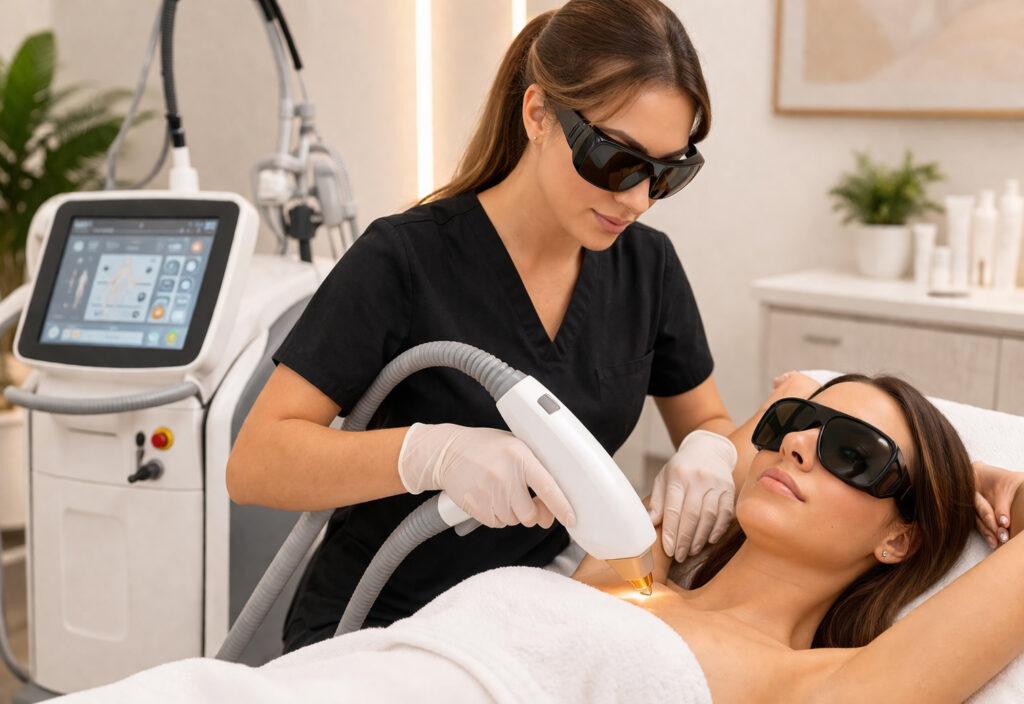
If you are comparing an esthetician vs laser technician career, you are likely at a crossroads. You know you want a future in the growing aesthetic industry, but you’re trying to figure out which path offers the right fit for your personality, your income goals, and your long-term professional dreams.
The beauty world has evolved. The growth of cosmetic lasers over the past two decades has blurred the lines between traditional skincare and high-tech medical aesthetics. Walk into many medical spas today, and you’ll see both licensed estheticians performing clinical facials and laser technicians operating sophisticated devices for permanent hair removal or skin tightening.
This guide is designed to clear the confusion. We’ll break down the legal definitions, the daily experience of each job, and the cosmetic laser training often required to enter today’s market.
Key Takeaways
The Core Focus: Estheticians specialize in hands-on skincare (facials, chemical peels, and products). Laser technicians are technology specialists who provide energy-based services for corrective results.
Training Commitment: Esthetics licenses typically require several hundred training hours. Laser certification is often a more focused, intensive path that may be completed in a few weeks of specialized coursework, depending on the program.
The Regulatory Maze: State regulations vary significantly. Some states allow for a “dual” role, while others may restrict certain laser treatments to specific medical professionals.
Where You’ll Work: Estheticians often work in relaxing day spas; laser technicians are frequently found in clinical environments like medical spas and dermatology clinics.
The Career Path: Many successful medical aestheticians begin with an esthetics license and then complete additional training to add a laser technician specialty to their skill set.

What Is an Esthetician?
Think of an esthetician as a “skincare coach.” They are skincare professionals who specialize in the health and beauty of the skin’s surface. Their goal is to help clients achieve a glowing complexion through manual treatments, expert product knowledge, and a deep understanding of skin biology.
To get licensed, you’ll attend a state-approved program. While education requirements shift depending on where you live, many programs range from 300 to 750 hours. For example, students in states like California or Texas often spend several months mastering everything from facial massage to makeup application.
The Scope of Traditional Esthetics
Licensed estheticians focus primarily on the stratum corneum—the outermost layer of the epidermis. Their work is preventative and maintenance-oriented. They are trained to identify skin types, manage common conditions like mild acne or dryness, and provide a professional environment that supports client skin health.

Common Services You’ll Provide:
Clinical Facials: Customized skincare treatments that deep-cleanse and nourish.
Advanced Peels: Using specialized chemical peels to brighten and refresh.
Skin Analysis: Helping clients understand their skin type and building an anti-aging routine.
Manual Exfoliation: Techniques like microdermabrasion or dermaplaning.
The Beauty Basics: Waxing, brow shaping, and lash enhancements.
If you want a deeper look at the esthetics side of this career path, read our guide on what a medical esthetician does.
What Is a Laser Technician?
A laser technician is a professional trained to operate high-tech laser equipment. This role is more technical and focused on cosmetic laser treatments. While an esthetician focuses on the feel and maintenance of the skin, a laser technician is focused on corrective results achieved through light and energy.
Because you are working with powerful cosmetic lasers, laser training is highly targeted. Most Laser Technician Certification programs focus on laser physics, safety protocols, and the “Fitzpatrick Scale” (how the patient’s skin reacts to light). This training often spans 16 to 40 hours of intensive didactic and hands-on experience, allowing you to enter the workforce as a specialist.
Common Services You’ll Provide:
Laser Hair Removal: Providing the long-term hair removal results that clients seek.
IPL Photofacials: Addressing sun damage, age spots, and redness.
Skin Rejuvenation: Using heat to stimulate collagen and improve skin tone.
Laser Tattoo Removal: Shattering ink particles with precision technology.
Acne Scar Revision: Helping clients improve skin texture through targeted device work.
You can also explore our guide on how to become a cosmetic laser technician.
A Day in the Life: Which Rhythm Fits You?
The Esthetician: A Nurturing Flow
Your day is built on client relationships. You might spend 60 to 90 minutes at a time with your clients, creating a restorative environment. You’ll discuss their lifestyle, their diet, and their general health as it relates to their skin. You might perform several high-touch facials a day, followed by waxing or brow appointments. If you love the artistry of skincare and the hands-on nature of the spa world, this is a natural path.
The Laser Technician: A Results-Driven Pace
Your day is often fast-paced and technical. You might see 10 to 15 clients a day for targeted laser procedures. Each session requires absolute focus—you are calibrating laser equipment, ensuring safety goggles are in place, and monitoring the skin’s reaction. You are the “problem solver” delivering dramatic results. Between sessions, you are documenting settings and monitoring for any adverse reactions. If you enjoy technology and clinical precision, you will likely thrive here.
The Science of Safety: Specialized Knowledge
One of the defining aspects of a laser technician career is the technical responsibility involved. You’ll develop specialized knowledge in the Fitzpatrick Scale, which classifies skin types I through VI based on melanin content.
While an esthetician uses this scale to choose a moisturizer or a peel, a laser technician uses it to prevent skin complications during complex treatments. Modern technology has made it possible to treat a wide variety of skin tones safely—but it requires a certified professional who understands the physics of light.
Why Melanin Matters
In cosmetic laser treatments, the laser’s energy is often attracted to pigment (melanin). In darker skin tones (Fitzpatrick IV–VI), the laser must be carefully adjusted to distinguish between the “target” (like a hair follicle) and the surrounding skin. Mastery of wavelengths like the Nd:YAG is essential for safety. This expertise is exactly why medical aestheticians with laser experience are in demand in diverse urban markets.
Understanding the Regulatory Landscape: A State-by-State Look
Texas: A Structured Pathway
Texas often serves as an example of a structured system for laser certification. The state recognizes multiple levels of laser hair removal professionals, from Apprentice to Professional. In some cases, you can enter this field with a high school diploma and a 40-hour course, provided you work under the supervision of a medical director.
California: The Clinical Focus
In California, the aesthetic industry is strictly regulated. Many laser treatments are considered medical procedures. This means they are often performed by medical professionals like nurses (RNs) or physician assistants. However, licensed estheticians frequently work in dermatology clinics, assisting with various laser procedures under direct medical supervision.
Florida: The Electrolysis and Laser Connection
Florida’s regulations are unique and often involve the Electrolysis Council. To perform laser hair removal here, you may need to pursue specific paths that involve becoming an Electrologist or a Laser Practitioner, depending on the current board rulings.
Arizona: Accessible Training Options
Arizona is known for having accessible career paths in the laser field. You can often become a certified laser technician by completing a state-approved course. While you may not be required to be an esthetician first, having a skincare background or previous aesthetics experience can still make you more attractive to employers.
Pro Tip: Since rules can change, always check your specific state’s Medical Board or Board of Cosmetology before choosing a program. A Laser Safety Course is often a great first step to understanding the local landscape.
Salary Potential: What Can You Expect?
In the aesthetic industry, specialized skills can often lead to higher income potential.
Estheticians: Income is typically a mix of hourly pay, tips, and product commissions. In luxury settings, an esthetician can build a stable living through a loyal client base. National averages often range between $40,000 and $60,000, depending on the market.
Laser Technicians: Because laser services are often high-value treatments, the revenue generated per hour is frequently higher. This can lead to a competitive laser technician salary, often ranging from $55,000 to $85,000, with higher potential in specialized surgery centers or busy urban clinics.
The Benefit of Dual Certification
The highest earning potential often belongs to those who are dual-certified. These medical aestheticians have the foundational knowledge of an esthetician and the technical skill to perform laser treatments. They are highly valued by medical spas because they can manage a client’s entire journey, from basic skincare to advanced corrective procedures.
Tuition and ROI: The Career Investment
If you are considering a career change, the time and financial investment are key factors.
Esthetics School: This is a comprehensive investment, often costing between $10,000 and $20,000 and taking 6 to 12 months. It provides a versatile, long-term license.
Laser Certification: This is often a more direct path into the clinical side of the industry. Costs can range from $3,000 to $5,000, and programs may take just a few weeks.
For many, starting with laser training is a practical way to enter a new career. With available Payment Plans, it is an investment that many find manageable as they begin working in the field.
Can an Esthetician Become a Laser Technician?
Absolutely. This is a very common evolution for professionals in the field. Many licensed estheticians find that after a few years of performing facials, they want to expand their service menu to include results-driven treatments.
The benefits of this hybrid path include:
Credibility: You can explain skin conditions from a biological perspective before using a laser.
Versatility: You become a more flexible asset for medical spas.
Client Trust: It is often easier to transition a facial client into a laser package when you have already established a relationship.
Most estheticians can complete additional training through a recognized cosmetic laser training program to gain these skills without another year of full-time schooling.
Esthetician vs Laser Technician in a Med Spa Setting
If your goal is to work in med spa careers, laser training is a significant advantage. While estheticians are vital for client retention, laser technicians often play a major role in high-revenue treatment services.
Medical spas focus on a “results-oriented” model. Clients visit for complex treatments that a traditional day spa may not offer. A laser technician fits this model well because their services are often sold in series (e.g., 6–8 sessions), ensuring measurable client outcomes.
Furthermore, working in a med spa usually involves supervision by a medical director, providing a professional clinical environment that many find rewarding.

Pros and Cons of Each Path
The Esthetician Path
Pros: Creative variety, deep client relationships, and flexible work settings ranging from resorts to doctor’s offices.
Cons: Can be physically demanding, and income may vary based on bookings and tips.
The Laser Technician Path
Pros: Specialized expertise in medical aesthetics, high per-session revenue, and a generally shorter path to initial certification.
Cons: Higher technical responsibility, need for constant technology updates, and navigating varying state regulations.
The Verdict: Which Path Is Yours?
There is no “wrong” choice—only the one that fits your goals.
Choose the Esthetician path if:
You are passionate about topical skincare and the wellness aspect of beauty.
You enjoy building long-term relationships with your clients.
You want a versatile license to work in luxury spas or start your own business.
Choose the Laser Technician path if:
You are excited by medical technology and results-driven medical procedures.
You want a specialized skill set in the growing medical aesthetics market.
You want a direct route into a clinical career.
The next step is up to you. Explore our Laser Training Courses, check out our Tuition Options, and see how focused study can help you reach your professional goals.
Frequently Asked Questions
Do I have to be an esthetician first?
Not necessarily. In many states, you can enter a laser technician career with a high school diploma and specialized certification. Always check your local state board regulations before enrolling.
Can I do both?
Yes. Dual certification as a medical esthetician can make you a highly valuable professional. Many people start with laser training to enter the workforce quickly, then complete additional esthetics training later.
Is it hard to learn the laser settings?
It requires focus and technical study. A high-quality laser hair removal training program should teach you the physics, skin interaction, and safety protocols needed for safe and effective operation.
Who oversees laser treatments in a clinic?
In most states, a medical director oversees the facility. They may delegate laser treatments to trained staff such as laser technicians, nurses, or physician assistants, depending on local regulations.
Which job is more in demand?
Both careers are growing, but medical spas are seeing significant expansion. This has created strong demand for skilled laser technicians and medical aestheticians, especially in larger urban markets.
Can I open my own business as a laser technician?
In some states, yes, although you will often need to work with a medical director because lasers are commonly treated as medical devices. Requirements vary by state and business model.
What is the best state to work in for aesthetics?
Large urban markets in states like Texas, Florida, and California often offer strong job opportunities, while states such as Arizona are known for more accessible laser certification pathways. Always review the current regulations and job market in your area.
Does laser training cover tattoo removal?
Many training programs include an introduction to laser tattoo removal, though some professionals choose additional advanced education for Q-switched or picosecond technologies used in more specialized tattoo removal work.
How often do I need continuing education?
Most licensed estheticians renew their license every two years, depending on state requirements. Laser technicians also benefit from regular continuing education to stay current with new technology, safety standards, and evolving treatment protocols.